 Documentation
Selecting LED strip cable cross-section
Two independent checks
Select conductor size using the strip manufacturer's calculator or by calculation. Keep voltage drop below approximately 5–7% of strip voltage to avoid reduced brightness. Also select a conductor and protective device that prevent overheating: heating depends on current, so 10 A at 12 V heats the same conductor as 10 A at 220 V. Long low-voltage cables supplied by powerful 12/24 V supplies may not produce enough short-circuit current to operate upstream protection. Provide appropriately rated protection on low-voltage branches.
Worked example
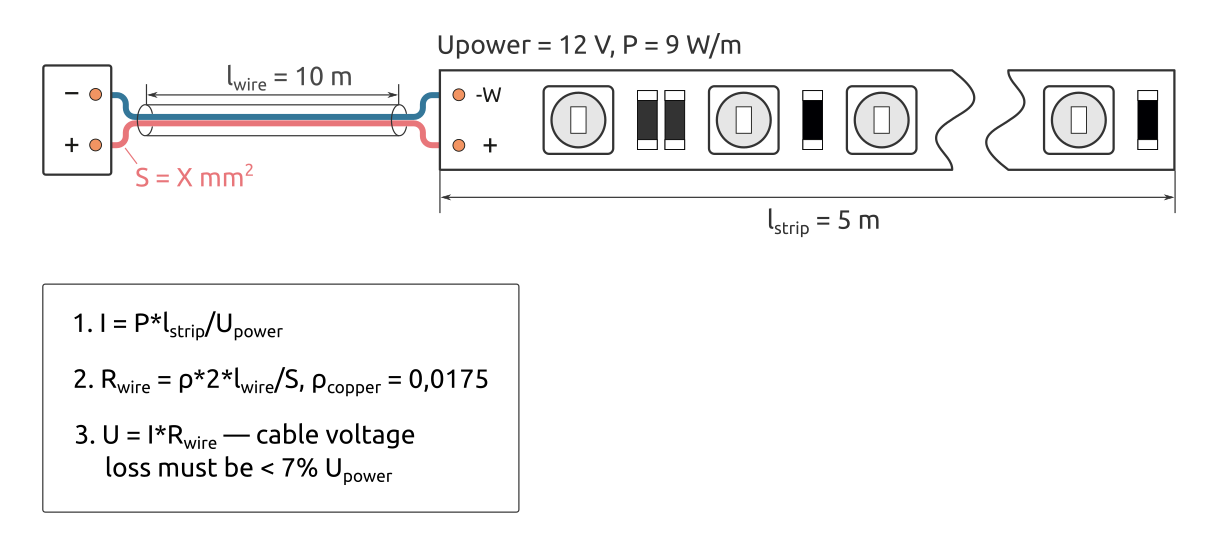
A 5 m, 12 V strip rated 9 W/m is connected using a 10 m cable. Current is I = P × length / voltage = 9 × 5 / 12 = 3.75 A. The source example uses a 1 mm² copper conductor for its thermal check; actual allowable current depends on installation conditions.
Round-trip resistance R = ρ × 2L / S = 0.0175 × 2 × 10 / 1 = 0.35 Ω. Copper resistivity is 0.0175 Ω·mm²/m. Voltage drop is I × R = 3.75 × 0.35 ≈ 1.3 V, about 11% of 12 V, so the strip is dimmer than intended.
With 1.5 mm², the drop is below 1 V. The source also suggests adjusting a suitable supply to 13 V; first ensure that the voltage at the strip, including short branches and light-load conditions, remains within its permitted rating.